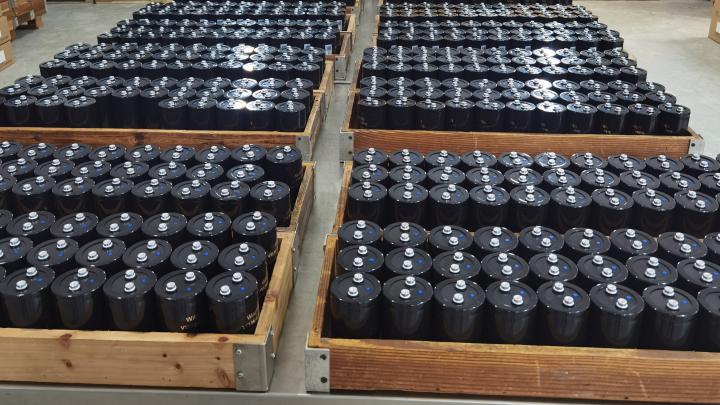
Summary: Best practices for storing and handling aluminum electrolytic capacitors. Learn how to preserve capacitor performance, avoid damage, and extend shelf life.
Improper storage and handling are among the most overlooked causes of premature capacitor failure. A capacitor that was perfect at the factory can be significantly degraded before it ever reaches your assembly line.
This guide covers everything you need to know about storing and handling aluminum electrolytic capacitors correctly.
Why Storage Conditions Matter
Aluminum electrolytic capacitors use a liquid electrolyte that can evaporate or chemically degrade over time. Additionally, the aluminum oxide dielectric layer slowly deteriorates when the capacitor is not charged. These two factors make proper storage conditions essential.
Key Risks of Improper Storage
- Electrolyte evaporation: High temperature accelerates electrolyte loss
- Dielectric degradation: The oxide layer thins when not charged (voltage-free storage)
- Mechanical damage: Vibration or impact can damage seals or terminals
- Contamination: Moisture or chemicals can attack terminals and labels
- Lead oxidation: Excessive humidity causes terminal oxidation, leading to poor solder joints
Recommended Storage Conditions
| Parameter | Recommended Range | Absolute Limit |
|---|---|---|
| Temperature | 5°C – 35°C | -25°C to 45°C |
| Relative Humidity | 25% – 75% RH | < 85% RH |
| Storage Period | < 2 years | < 3 years |
| Atmosphere | Normal air | No corrosive gas |
| Vibration | Minimal | Avoid dropping |
Temperature: The #1 Factor
- Never store above 40°C: Electrolyte evaporates rapidly at elevated temperatures
- Avoid direct sunlight: Solar radiation can raise local temperature significantly
- Cold storage is safe: Low temperature actually extends shelf life — but avoid condensation when returning to room temperature
Humidity Control
- Avoid high humidity: Moisture attacks terminals and can cause corrosion
- Avoid rapid humidity changes: Condensation forms when cold capacitors are moved to warm, humid air
- Use desiccants: In humid climates, store in sealed containers with silica gel packets
Shelf Life and Reconditioning
Typical Shelf Life
Aluminum electrolytic capacitors can be stored for up to 2 years at recommended conditions without performance loss. Beyond 2 years, the oxide layer may thin, causing elevated leakage current.
| Storage Duration | Condition | Action Required |
|---|---|---|
| < 1 year | Recommended conditions | Use directly — no action needed |
| 1–2 years | Recommended conditions | Recommended: apply voltage per reconditioning procedure |
| 2–3 years | Recommended conditions | Mandatory: recondition before use |
| > 3 years | Any | Test thoroughly; consider replacement |
Reconditioning Procedure
When capacitors have been stored for more than 1 year without being charged, the oxide layer should be reformed by gradually applying voltage:
Step 1: Apply 25% of rated voltage for 30 minutes
▼
Step 2: Apply 50% of rated voltage for 30 minutes
▼
Step 3: Apply 75% of rated voltage for 30 minutes
▼
Step 4: Apply 100% of rated voltage for 1–2 hours
▼
Step 5: Measure leakage current — must meet specification
Note: Use a DC power supply with current limiting set to 10–20% of rated capacitance (in µA). Monitor for excessive heat — if the capacitor becomes warm during reconditioning, reduce the voltage and increase the step duration.
Handling Best Practices
1. Unpacking and Inspection
- Check packaging integrity before opening — reject any damaged packages
- Inspect terminals: Look for oxidation (dull gray), deformation, or contamination
- Check case seals: Any cracks or electrolyte residue indicate damage
- Verify polarity markings: Confirm the negative terminal stripe is visible and legible
- Avoid fingerprints on terminals: Skin oils can affect soldering quality
2. Before Assembly
- Do not pre-bend terminals unless specified in the datasheet
- Keep capacitors at room temperature for at least 2 hours before soldering if moving from cold storage
- Sort by date code: Use the oldest stock first (FIFO — First In, First Out)
- Check capacitance and ESR if storage duration is uncertain
3. During PCB Assembly
- Observe polarity: Double-check the negative terminal (-) stripe alignment
- Soldering temperature: Maximum 260°C for ≤ 10 seconds (wave solder) or 260°C peak (reflow)
- Do not apply mechanical stress during soldering — the capacitor body must be supported
- Avoid touching the case immediately after soldering — it will be hot
4. Screw Terminal Capacitors
- Torque specification: Follow the torque values in the datasheet (typically 1.5–3.5 N·m for M5/M6 terminals)
- Do not overtighten: Excessive torque can damage the terminal seal
- Use a torque wrench: Do not estimate by feel for critical applications
- Busbar mounting: Ensure the busbar is flat and makes full contact with the terminal
| Terminal Size | Recommended Torque | Maximum Torque |
|---|---|---|
| M4 | 0.8 N·m | 1.2 N·m |
| M5 | 1.5 N·m | 2.0 N·m |
| M6 | 2.5 N·m | 3.5 N·m |
| M8 | 4.0 N·m | 5.0 N·m |
5. Post-Assembly
- Initial power-up: Apply full voltage gradually if the assembly was stored after loading capacitors but before first use
- Burn-in test: New equipment should run at full rated power for 2–4 hours before shipping
- Visual inspection: Check for any swelling, electrolyte leakage, or discoloration
Common Storage Mistakes and Consequences
Mistake 1: Storing in a Hot Warehouse
- Problem: Warehouse temperature 40–50°C in summer
- Consequence: Electrolyte evaporation reduces capacitance and increases ESR
- Solution: Use air-conditioned storage for large capacitor inventories
Mistake 2: Long-Term Storage Without Reconditioning
- Problem: Capacitors stored 3+ years and used directly in equipment
- Consequence: High initial leakage current can cause equipment malfunction or capacitor failure
- Solution: Always recondition capacitors stored more than 1 year
Mistake 3: Mixing Old and New Stock
- Problem: Older capacitors mixed with new deliveries
- Consequence: Old capacitors may fail prematurely, causing field failures
- Solution: Implement strict FIFO inventory management with date code tracking
Mistake 4: Ignoring Humidity in Tropical Climates
- Problem: Capacitors stored in unconditioned space in Southeast Asia (85%+ RH)
- Consequence: Terminal oxidation reduces solderability; moisture ingress can damage capacitors
- Solution: Store in sealed containers with desiccant; inspect all old stock before use
HUAYU Packaging Standards
HUAYU capacitors are packaged to protect against common storage hazards:
- Anti-static bags: Prevent electrostatic damage and moisture ingress
- Individual protective sleeves: Prevent mechanical contact between capacitors
- Corrugated cardboard boxes: Absorb shock and vibration during transport
- Desiccant packets: Maintain low humidity inside boxes
- Date code labeling: Enables FIFO inventory management
- Storage instruction labels: Printed handling guidelines on each box
Contact our sales team to discuss your capacitor requirements and request a custom quote.
Next article: “How to Find a Compatible Replacement Capacitor” — subscribe to our blog for updates.
Need Help Selecting the Right Capacitor?
Contact HUAYU’s engineering team for technical support and custom capacitor solutions. Get a quote →