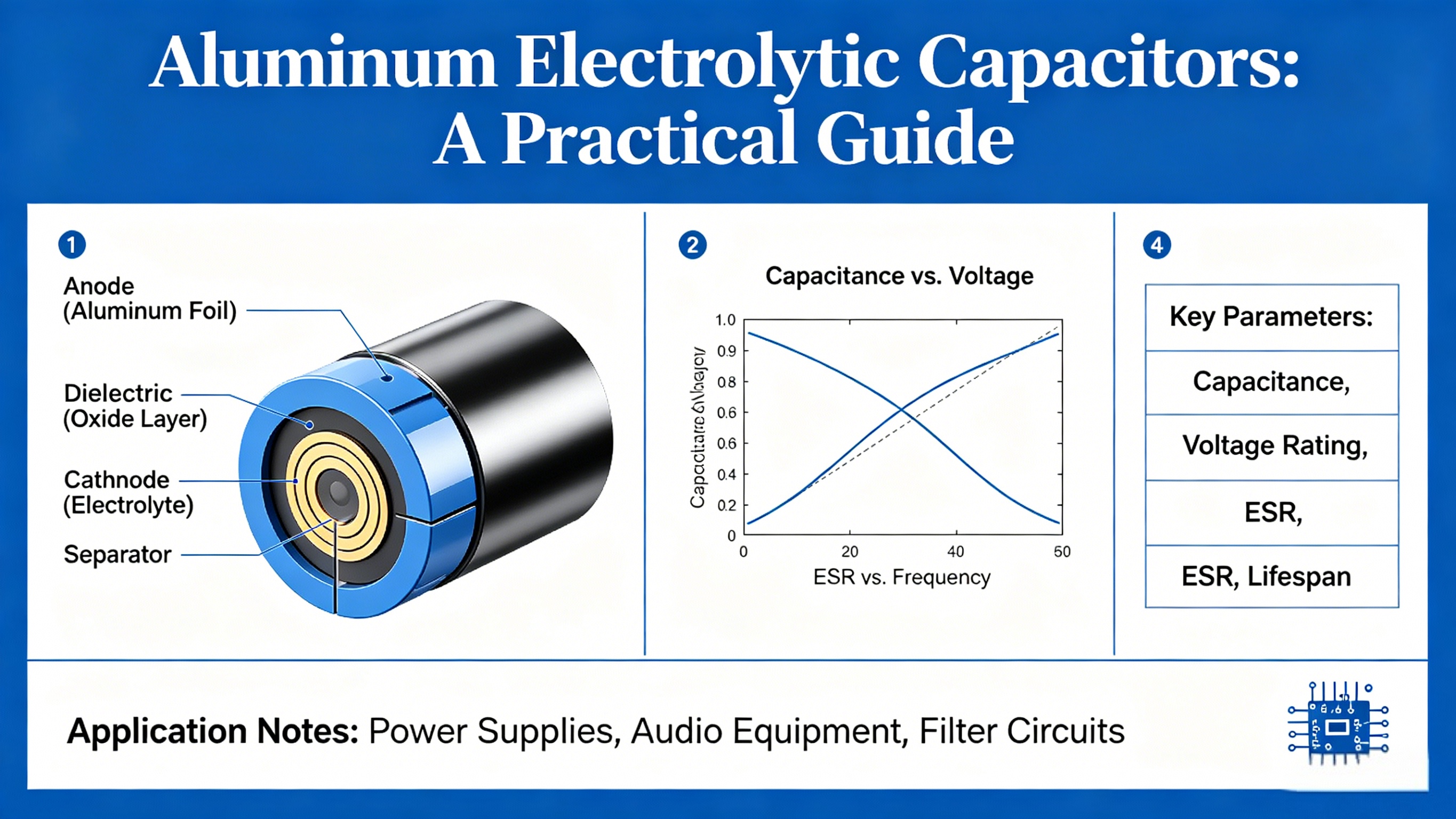
Summary: A comprehensive guide to understanding aluminum electrolytic capacitors — how they work, key parameters, and how to select the right one for your application.
Aluminum electrolytic capacitors are the workhorses of power electronics. If you’ve ever opened a frequency inverter, UPS, or welding machine, you’ve seen them — those cylindrical cans with snap-in or screw terminals.
This guide covers the fundamentals every engineer should know.
How They Work
An aluminum electrolytic capacitor consists of:
- Anode: Aluminum foil, electrochemically etched to increase surface area
- Electrolyte: Liquid or solid conductive medium that acts as the cathode
- Oxide layer: A thin Al₂O₃ film formed on the anode — this is the actual dielectric
The oxide layer is self-healing: if a defect occurs, the electrolyte reforms the oxide at the fault site, restoring insulation.
Key Parameters You Must Understand
1. Rated Voltage (V)
The maximum continuous DC voltage the capacitor can withstand.
Rule of thumb: choose a rating 20–30% above your maximum operating voltage.
| Application Voltage | Recommended Rating |
|---|---|
| 400V DC bus | 500V |
| 24V DC link | 35V |
| 48V system | 63V |
2. Capacitance (µF)
Larger capacitance = more energy storage and better ripple filtering.
Capacitance decreases with age and temperature — check the capacitance tolerance (typically ±20%).
3. Ripple Current (A rms)
This is the most critical parameter for power electronics. The capacitor must withstand the AC current superimposed on the DC bias.
Too little ripple rating = overheating = premature failure.
At HUAYU, every series has a specified maximum ripple current at 105°C, 100–120 Hz. Derate for:
- Higher frequency (ripple capability increases)
- Lower temperature (check the frequency multiplier curve in the datasheet)
4. ESR (Equivalent Series Resistance)
Lower ESR = less heat generation and better high-frequency performance.
Snap-in and screw-terminal capacitors typically have ESR in the mΩ range.
5. Operating Temperature & Lifetime
Standard ratings:
- 85°C / 2,000h (economy grade)
- 105°C / 2,000h–5,000h (industrial grade, what HUAYU specializes in)
- 125°C / 2,000h–5,000h (high-reliability)
Lifetime doubles for every 10°C reduction in operating temperature (Arrhenius law).
A 105°C / 5,000h capacitor running at 65°C can last 80,000+ hours (>9 years).
Snap-In vs. Screw Terminal: Which to Choose?
| Snap-In | Screw Terminal | |
|---|---|---|
| Diameter | 22–90 mm | 35–115 mm |
| Current capability | Up to ~10A ripple | 10A+ ripple |
| Mounting | PCB / chassis snap-in | Busbar / heavy-duty screw |
| Typical use | VFD output, SMPS | UPS, welding, large inverters |
| HUAYU series | CD17FX, CD292–CD298 | CD92, CD135, CD136 |
Common Application: VFD DC Link
In a variable frequency drive, the DC link capacitor:
- Smooths the rectified AC into stable DC
- Handles motor regeneration energy
- Filters high-frequency ripple from the inverter stage
Selection checklist for VFD design:
- Voltage rating ≥ 1.2–1.3 × peak DC bus voltage
- Ripple current rating ≥ calculated RMS ripple (check at fundamental frequency)
- Temperature rating = 105°C minimum for industrial environments
- Expected lifespan matches your equipment design life
- Case size fits your enclosure + clearance for ventilation
Why HUAYU?
Since 1987, we’ve focused on large-can aluminum electrolytic capacitors — the ones that matter in demanding industrial applications. We offer:
- 17 standard series covering snap-in (22–90mm) and screw terminal (35–115mm)
- Custom specifications: non-standard voltage, capacitance, case size, terminal configuration
- Rigorous testing: each capacitor undergoes formation, aging, and electrical testing before shipment
- Global export experience: serving customers in 50+ countries
- OEM/ODM services: Full customization with your brand
Contact our engineering team to discuss your capacitor requirements and request a custom quote.
Next article: “How to Select Aluminum Electrolytic Capacitors for VFD Applications” — subscribe to our blog for updates.
Contact HUAYU's engineering team for technical support and custom capacitor solutions. Get a quote →